Created by
Kemi King
Fellow, Caring Cultures 2025
Featuring work by
S.H. Ali, Jacqueline Cantar, Jeff, Alyssa Vernon, Becca, Kemi King
Edited by
Kemi, Jeff, Becca
Published
February 6, 2026
View creators’ original zine
(Page-by-page view, in English only, without alt-text descriptions)
Introduction
By Kemi King
Sanctimonious, as in you’re actually an asshole,
as in the idea of moral superiority.
As in, you do not know me.
Sanctimonious, as in “doesn’t sound like you are concerning yourself with disabled artists and safer labour practices in your politic.
Message received.”
A true line from a conversation that ignited my want to create this paper in the first place. Context in a moment but, I believe we as a society need to learn to lead with curiosity rather than accusation. Especially, when something does not seem in tandem with your perception or understanding of a person. Or maybe, the third secret thing is to not engage.
Building community is hard work, and yet community is also your literal neighbour. Our communities will not always be perfect and easy, they actually should not be – as to be in community is to be challenged in supporting one another’s’ needs, it is boundary setting, sacrificing your comfort for somebody’s need; it is an engagement of good faith.
Context: somebody had messaged my organization offering support to action against a change that was happening within another community organization. I responded, naming that this support was not needed, and that my belief (knowledge) was that this change was a choice that had to be made. It’s difficult at this point to summarize the conversation, and the impulse to share a screenshot is no longer there – but as with everything, there is more context and more words that were exchanged.
Unfortunately, the person responded as they did – a tad haughty, but mostly uninformed, and accusatory.
Or maybe, the third secret thing is to not engage.
Fortunately for them, a kindness had to be upheld as I was representing the organization. I am an Aries, but I am also a professional.
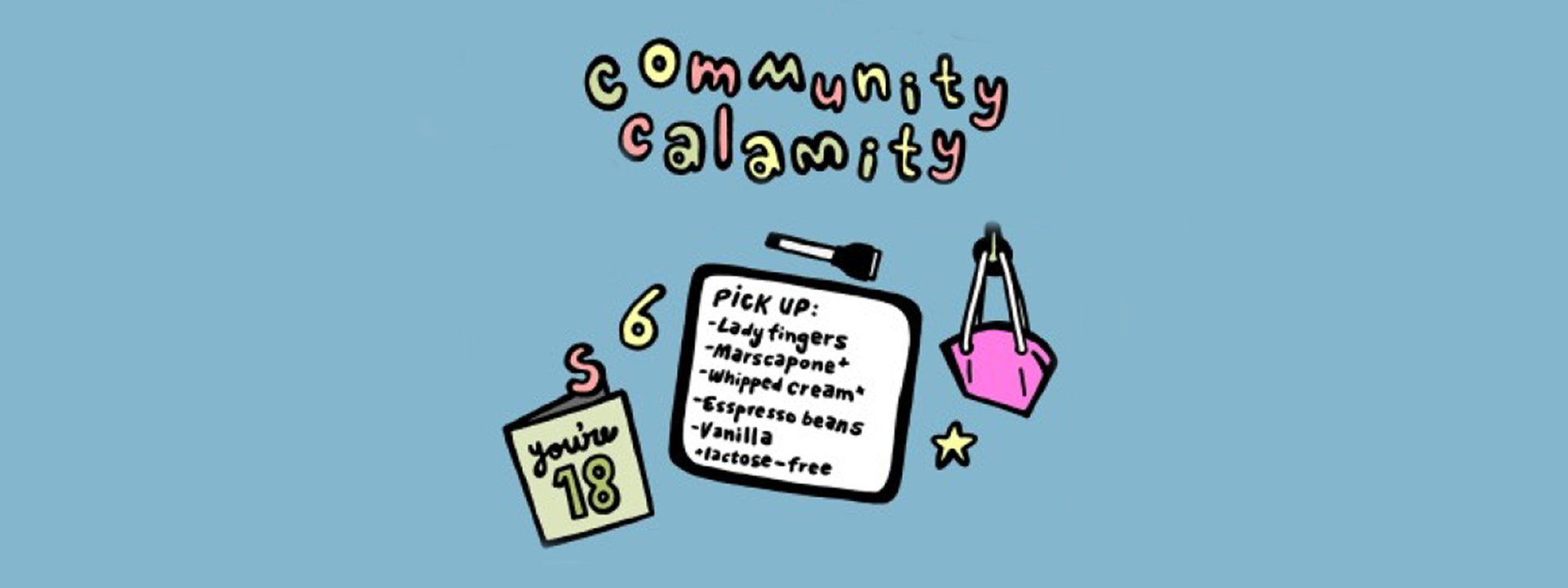
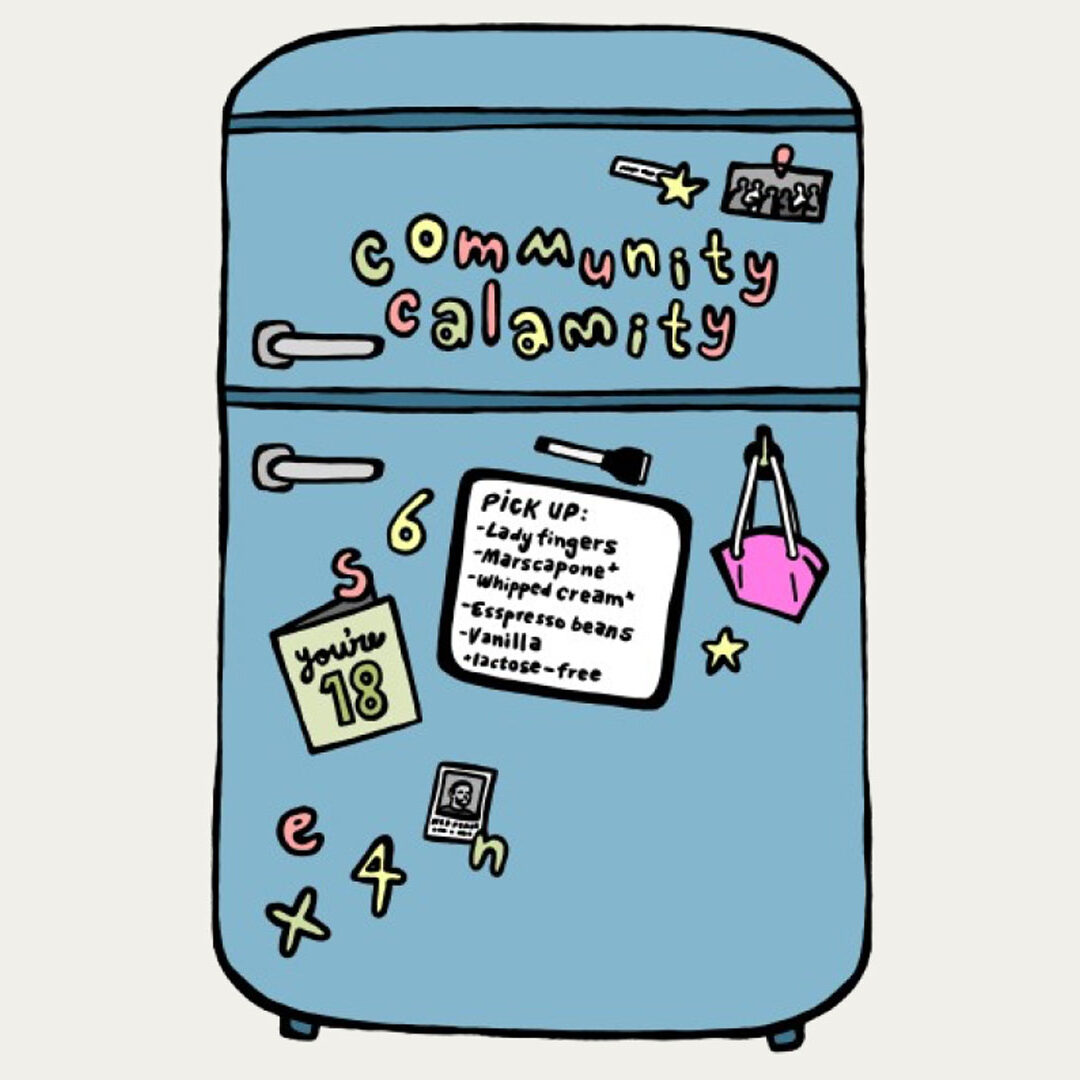
Fortunately for me, I got to this idea of Community Calamity; a community newspaper to explore my practice of critical care. This paper is made up of responses from arts workers and community aid workers, from the Halton Hamilton area (mostly).
Through writing, artwork and tweets from twitter.com, the newspaper is holding a small breath of practices of care and the performances it necessitates. The experiences of the contributors are real, and there are real consequences, and sometimes even lives are at stake for the work being shared here yet at the same time there needs to be space for love, for joy, space for the truth of the matter worded in a way that’s silly-goofy. This community newspaper is holding all of that, and sometimes less. This paper is a practice of care for those who are often caretakers and leaders, for some a space for knowledge sharing, for others (me) a space to vent and hold, without response, the qualms of being an organizer.
Community Fridges
By Jacqueline Cantar

WE DON’T HAVE TO BE FRIENDS TO FEED EACH OTHER.
Early in the pandemic, people rallied together to care for each other in inspiring ways. At the time, I was a nanny. The family I worked for was stuck abroad for months; I was house sitting for them. My second niece had just been born and I could barely see her. I was feeling isolated and like I had extra care and time to give to my community. I felt some barriers though: a manipulative relationship in my past left me with a looming discomfort in local social circles, and it can be a little difficult to get involved when you don’t drive. But I also felt like, “if not me, who?”. I recognized the privileges I held as a white, employed, independent person, and felt I should be contributing in whatever way I could.
Inspired by initiatives like Community Fridges Toronto and In Our Hearts NYC, a group chat formed in hopes of starting a community fridge in Hamilton. Mostly strangers, still social-distancing, and unsure of how to go about it, things moved slowly for several weeks. We needed more help and I was driven to push things forward. With the group’s permission, I took things to social media, figuring that more public awareness would get us closer to our goal. It worked. Within 5 months, we opened three community fridges, spread across the city. We became a large volunteer group, with even more people donating, and still more visitors who were able to access food and necessary supplies. We supported other groups in the city, and in other cities too, in opening even more community fridge locations. As a continuation from our inspirations, we too inspired others.
Being a 24/7 operation, there were daily demands and I struggled to take breaks. As a group, we strived for a shared distribution of responsibility, but naturally, some had more time to give than others. My “founder” identity was promoted by some, but then also resented. There were tensions at times, rarely worse. Constantly aware of things that needed tending to (donation pickups, broken things, emails), I learned to filter many things through the people I felt understood by, so that requests and reminders weren’t always coming from me. I didn’t want people to feel nagged by me. I wanted people to feel empowered to see their ideas through and to take on more of the work. I wanted to learn from my peers who worded things in ways that weren’t taken poorly. I wanted to learn how to take breaks.
Eventually, I was back in the thick of childcare, learning how to be the best caregiver I could be to young siblings at different stages in life, during a pandemic. In both instances, I learned to exercise more patience. Throughout, I witnessed many different ways of processing, and I don’t take them personally. Though I do think we could give each other a little more grace at times, we don’t have to be friends to feed each other.
Caring for the Vulnerable: The Success of Peart
By S.H Ali
I’m going to tell you the story behind a significant legal case. It’s an important story, and it begins about a 30-minute drive from Hamilton, in Brant County. The case followed the tragic death of Ned Peart, a worker from Jamaica that came to Ontario, Canada through the Seasonal Agricultural Workers Program (SAWP).
Ned Peart died in 2002 while working at a tobacco farm in Brant County, crushed by a thousand-pound tobacco bin at 39-years-old. He had been supporting six kids back in Jamaica. Now, if he had been working construction or mining, a mandatory inquest would have occurred, meaning the coroner would have to investigate the cause of death to understand how it happened, if it was preventable, to see if anyone is liable, and how to reduce future risk. However, because Peart was a migrant farmworker under SAWP, the coroner was not required to investigate the death. The case highlighted the disparity in policy surrounding mandatory coroner’s inquests and worker safety, and revealed how Canada discriminatorily regulates and protects labour in different industries.
Ned’s brother Wilbert took on the case. The tragedy sparked a movement; people came together, and the story got out. Thanks to the bravery and comradery of Wilbert Peart and the community that rallied behind him, the Peart case succeeded in documenting evidence of the systemic abuse suffered by migrant farmworkers. The case was lost on jurisdictional technicalities, on the courts’ ability to question legislation, but the victory of that case stands; the truth was documented.
The accepted evidence and official record included an acknowledgment of structural issues—difficulties flowing from the closed nature of tied work permits, the constant risk/threat of repatriation (essentially deportation), issues with relying on the employer you are tied to for housing and health care, social isolation and lack of services, an unjust worker selection process that employers manage, the lack of sanctions against worker abuse, and the unmitigated health and safety risks of the labour.
Similarly, poor and inhumane working conditions were established in the evidence of this case. This includes inadequate facilities for food preparation and storage, crowded sleeping areas, poor ventilation, lack of comfort and privacy, lack of laundry facilities, a lack of health and safety training, and a lack of safety equipment (despite the use of pesticides and other harmful or toxic materials that cause cancer and neurotoxic damage). Expert evidence clarified the rate of death in this work being 20 times the average and established a high rate of musculoskeletal disorders and injuries.
THE VICTORY OF THAT CASE STANDS; THE TRUTH WAS DOCUMENTED
All this detailed evidence can be found in the publicly available 2014 Human Rights Tribunal decision, between paragraphs 55 and 128. Use the free CanLII website and search for “Peart v. Ontario (Community Safety and Correctional Services), 2014 HRTO 611”. I encourage you to read these details and share them widely as well.
These details represent official legal documentation of the exploitative and oppressive realities created by temporary foreign worker programs like SAWP. And again, this stuff is happening right now about a half- hour drive from Hamilton (and in many, many other places in Ontario).
I believe that it is our human duty to witness and share in the pain suffered by others, and to seek justice for those that have suffered injustice. The Peart case exemplifies the hard work of a community resulting in the speaking of truth to power. Migrant farmworkers are uniquely and painfully voiceless in Ontario, and thus unable to effectively advocate for themselves. The harsh truth is that a lack of care has resulted in slavery in our backyard.
Caring is critical because a community is strongest, and most human, when advocating for its vulnerable.

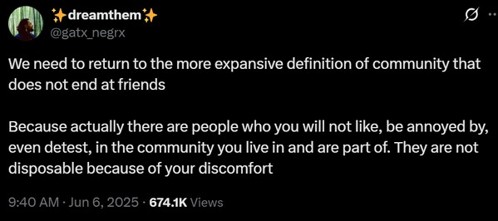
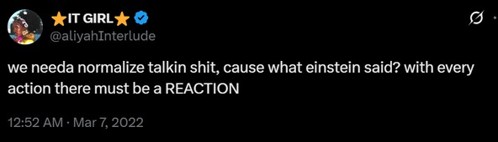
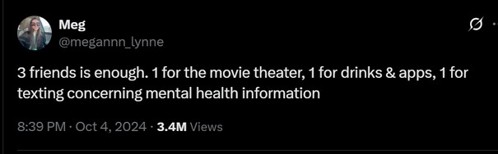
Zodiac Signs
By Jeff & Kemi
Capricorn
22 December – 19 January
Aquarius
20 January – 18 February
Pisces
19 February – 20 March
Aries
12 March – 20 April

Taurus
20 April – 20 May
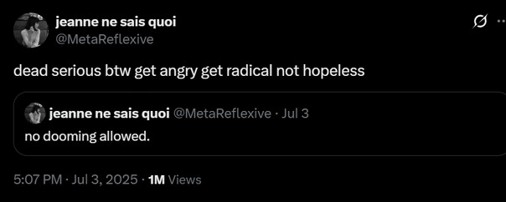
Gemini
21 May – 20 June

Cancer
21 June – 23 July
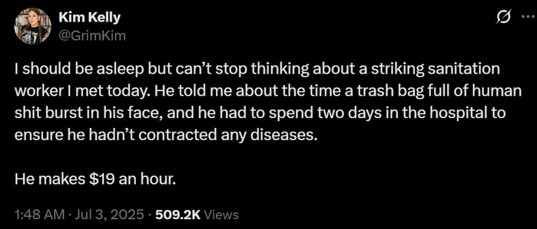
Leo
23 July – 23 August
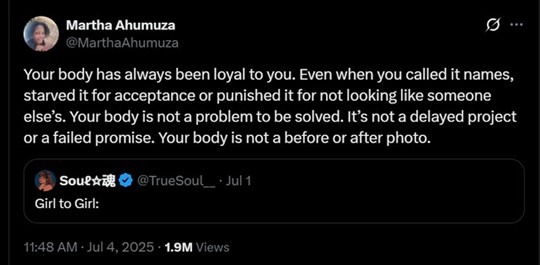
Virgo
24 August – 23 September
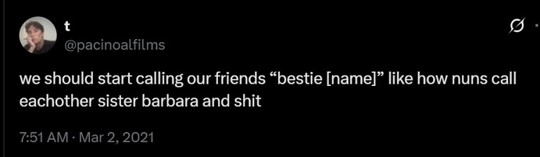
Libra
23 September – 23 October
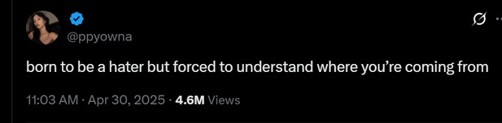
Scorpio
24 October – 21 November
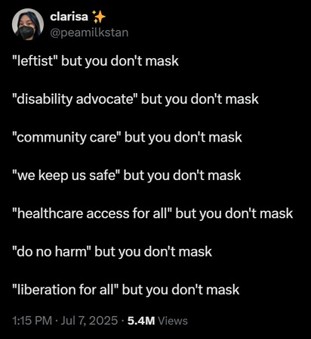
Sagittarius
22 November – 21 December
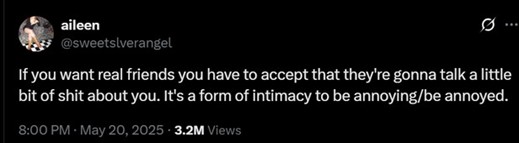
Maskne, the TTC, and Community
By Becca
EXCUSE ME,
SORRY TO BOTHER YOU,
BUT WHY DO YOU WEAR THAT MASK?
A young man, celebrating his 18th birthday alone on the subway with a beer in his hand, asked me and my friends as we boarded and took seats near him. He asked so politely a question I know so many people have wondered in the past 4 years, but that I have never really had to answer out loud.
There was a beat before I chose my words… I knew that I wanted this conversation to be an invitation to share my perspective and maybe to see if he would want one of the spare masks I always carry with me. Then, his next statement:
I CONSIDER MYSELF A
BIT OF AN ANTI-MASKER.

As a healthcare worker, that statement means more to me than his initial explanation: “I don’t like the way the mask feels on my face”. It means that you take no stake in herd immunity, that you don’t approve of masks and that you maybe didn’t even mask when we had too many bodies in the hospital morgues and we needed to hire refrigerated trucks to hold them, or when my colleagues could not leave the hospital to see their families for weeks and some never did again, dying on the COVID wards.
I took an oath to do no harm. So as much as I wanted to shake some sense into this kid, I couldn’t. Instead, I did the math: he was 13 when the pandemic started. I pictured him in my clinic – I see lots of patients with wildly different views than me, and we have to work together and find a common goal. For this kid: he says he cares about his health. He goes to the gym, he tries to eat healthy, he goes to the doctor and yeah, he says, his doc told him to cut back on his drinking but he’s not ready for that yet. Still, he did not think that masking to prevent illness was worth it, because he was healthy and probably wouldn’t get really sick, plus don’t infections build your immune system?
Next it was important to understand why he didn’t like masking. His biggest problem with the mask? “Before the pandemic I never had acne and once I started wearing the mask, it erupted”. He was 12, the pandemic started, he went through puberty, now he’s 18.
The mask is not the only reason he had acne, and it might not have been the reason at all. However, it is the reason (or so I believe) that I have not gotten sick throughout my hospital- based training, not even once. I am the only one of my cohort who wears a mask, and I have taken the fewest sick days. I shared these thoughts with him, but he’s just turned 18, he’s drunk, and he’s on the subway alone.
Ultimately, he doesn’t change his mind that night; he doesn’t accept the offered mask, and I don’t expect him to. I think the point of that conversation for me was not to change his mind, but it was to engage and care for my community: both this young man and the people he will interact with in the future. My goal was to have the conversation without making him feel judged so that, just in case he ever sees another group of people in masks, he might understand why a bit better; he might not tell them he’s an anti-masker or try to argue the same points. Maybe he will (miraculously) remember this conversation, and maybe he will even ask them for an extra mask.
In case you somehow ever read this, TTC boy, here are some pieces of unsolicited advice I want to share with you – take it or leave it, these are things I have been thinking about since our chat:
- Thank you for asking questions to strangers when you don’t understand something and for engaging in the conversation earnestly, it helped me do the same and I learned a lot from that convo.
- If the reason you don’t want to mask is acne, we have treatments that might help! You could ask your doctor if a topical retinoid is safe for you.
- If your doctor is concerned for your liver at 18, please ask them questions the same way you asked us questions, and if you don’t feel safe with your provider, look for local harm reduction resources to consume in a safer manner.
- Vaccines for many illnesses, including COVID-19, provide you with immunity without as many risks to your body (short or long term) as infection.
- Masking is not just to protect you, but to protect those around you who might not be able bodied.
- 18 is an exciting age and an important time to develop safe relationships. Think about how you would like to move through the world, prioritize treating others with respect and expecting the same back from that them.
We don’t have to agree, but it’s easier to find common ground when we listen to each other. We don’t have to change our beliefs for others, but we have to be open to change:
DO THE BEST YOU CAN UNTIL YOU KNOW BETTER. THEN WHEN YOU BETTER, DO BETTER.
Maya Angelou
To me, that is what community is.
Love,
Dr. Bec
Terrible Soup
By Becca & Kemi
Attempted 2021 – Written 2025
This delicious and unbelievably difficult Tiramisu recipe is made with raised voices, disappointment, tears, and espresso-soaked lady fingers. Lactose free mascarpone, cocoa powder, and a blender (you’ll see).
Who doesn’t love when a recipe goes horribly wrong? It’s one of the best things about this tiramisu recipe. If you’re looking for a life lesson in a dessert, look no further.
This recipe has been a long time coming, made first four years ago when we were test-driving living together for the first-ish time. We’re actually quite proud of this recipe, and wanted to turn it, and others, into a full-fledged book that held our baking failures and resulting philosophies.
Un/fortunately, we’ve just been too good at baking since.
By “too good” we mean we just haven’t taken a gamble like this since, sticking to what we know: cookies and banana bread.
In case you’re not familiar with it, Terrible soup is what happens when you fuck up the popular Italian dessert, and it does not hold.
Should you try it anyway? No, don’t, you don’t need the recipe for the lesson.
What makes our Recipe different:
Well, first of all, we did not actually buy all the proper ingredients, we bought the lady fingers, and the lactose free mascarpone – but the liquor was amaretto, and we used lactose free 10% cream.
Traditional tiramisu uses raw eggs, and sugar, but the recipe we followed used whipping cream, which disclaimer is NOT the same as 10% cream.
The result was meant to be delicious and easy.
INGREDIENTS YOU’LL NEED:
- LADY FINGERS: FROM THE GROCERY STORE
- MASCARPONE: LACTOSE FREE FOR UR TUMMY
- COFFEE: WE USED ESPRESSO
- HEAVY WHIPPED CREAM
- GRANULATED SUGAR
- VANILLA EXTRACT: REAL OR FAKE, BUDGET DEPENDENT
- COCOA POWDER: FOR THE TOP
How to make Terrible Soup
Mix creamy filling: you’ll be using a hand whisk, and your own idea of what a stiff peak is (btw, you’ll be wrong).
Dip lady fingers. in the espresso and liquor: shudder at the smell of the amaretto, because it’s thirty percent alcohol, instead of the 15% coffee liqueur. Dip the lady fingers into whatever bowl you have, on both sides, don’t let them soak.
Layer mascarpone: so, it’s meant to be a smooth layer of whipped cream mixture to be placed on top of the lady fingers but it will be watery…This is where we wondered if we should continue, we should not have continued.
Repeat: despite your growing worry, and your lady fingers starting to disintegrate.
Refrigerate: so, ideally this thing is kinda already able to hold its own but that will not be your truth. To compose yourself, you will refrigerate for an hour.
What is tiramisu anyway? I mean, is it about the form or is it about the flavours, and passion for Italian cuisine? It is about giving it your all, no literally – all, we spent all day making this soggy, unstructured soup. I mean, what really is the essence of tiramisu? Is it about the destination? Or the friends we made along the way?
Blend: It’s already halfway to ice cream anyway.
Freeze: for 2-24 hrs depending on how much am*retto was used.
Enjoy?
What kind of lessons did we learn?
Less lesson more of a reminder?
For us, it boils into this idea of good faith. We’ve got to trust that the people, the community are trying their best even when the instructions are right there.
I (Kemi) was reminded of the queer art of failure by J. Halberstam, a text about finding alternatives to conventional understandings of success within a heteronormative, capitalist society (Halberstam, 2011). It was about the alternative, what else could be done with the circumstances we are in, and we may have made for ourselves?
For me (Becca), it was an opportunity to recognize the freedom of going off script. When I bake, it is always from a recipe, and I never stray from it. It was exciting to find a way towards art and play, by deviating from the rules. The best part was the opportunity to think about how this ‘mistake’ can be bigger than just the moment. It’s exciting to think about sharing this recipe here with you, because the revolution exists within the sharing.
Though we wouldn’t share the soup/ice cream itself – because we love you too much.
Consider trying the actual recipe and following it. Lauren Allen’s Easy Tiramisu recipe on Tastes Better from Scratch.
Community Listens Beyond What’s Seen
By Alyssa Vernon
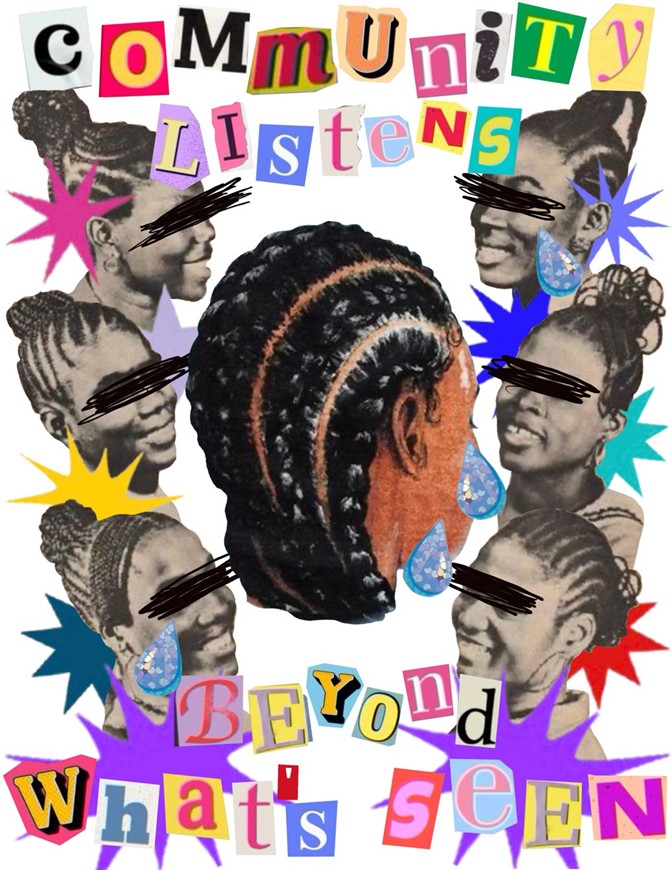
I asked my community via Instagram to fill in the blank: “Community is .” Their responses included, “home, suicide prevention, antithesis of capitalism, life-affirming, solidarity, growth, common humanity, accountability, roots, etc.”. I took their thoughts and created this collage that symbolizes collective care, grief, and the radical act of listening.
Community Listens Beyond What’s Seen explores how we hold each other in community. At the center, the braided figure grounds the piece as she’s a visual representation of community care passed from generation to generation. Her tears speak to the weight of grief, harm, and conflict that happens within communities and the desire to be fully listened to and understood by one’s community.
This collage encourages us to practice listening not to respond, but to hear, understand and witness each other in community with intention. This piece calls for truth-telling that doesn’t make us flinch – confrontation held in care, conflict rooted in commitment. It asks: how do we stay with each other, even when it’s hard? How do we listen to each other beyond seeing?
© Kemi King, et. al, 2025.
All texts and artwork are published with the permission of the artist. The creation and publication of this work was made possible with the support of Canada Council for the Arts, Government of Canada, Ontario Arts Council, and Government of Ontario.